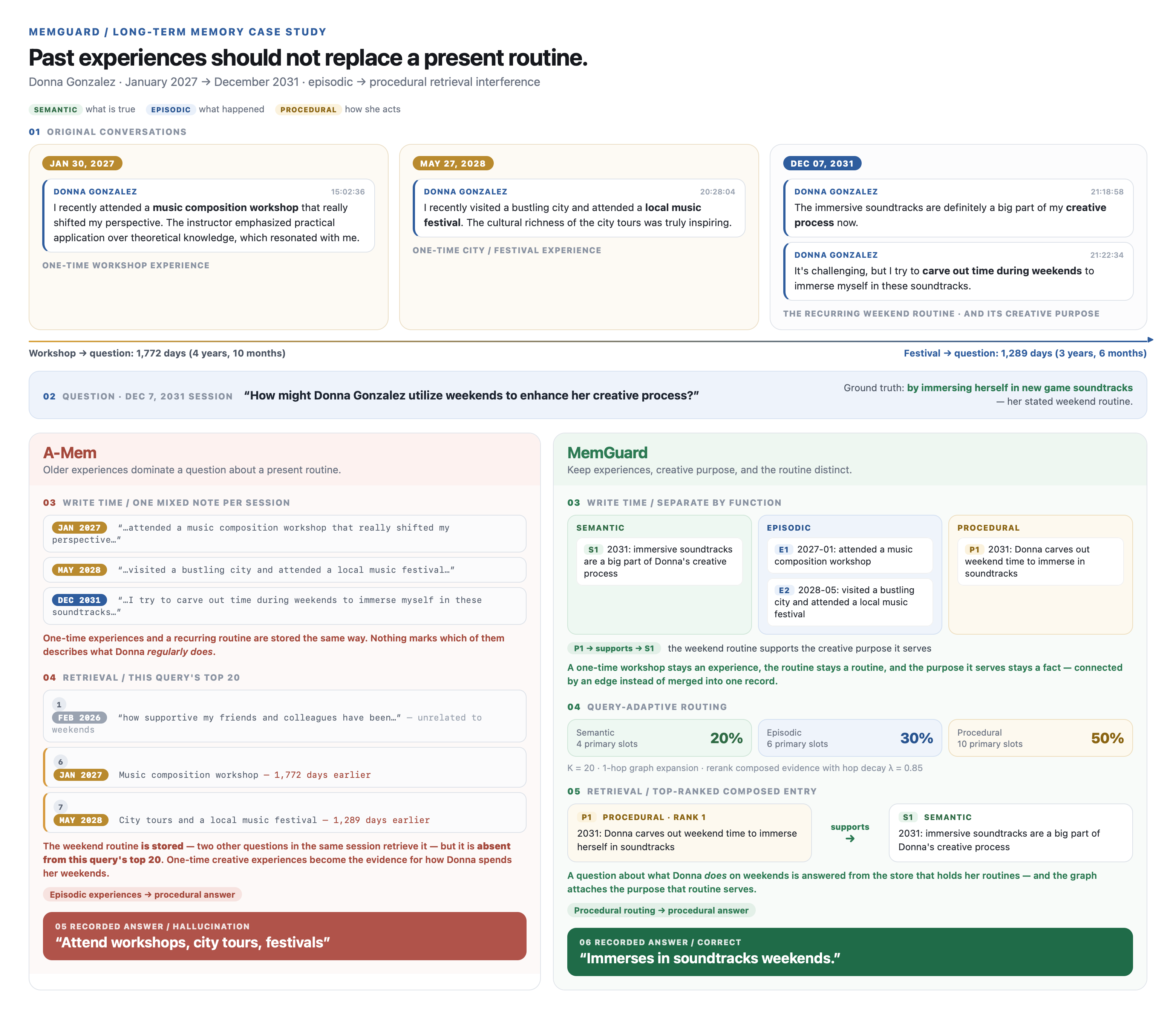
In this recorded case, Donna's old creative experiences displace her stated weekend routine.
MemGuard preserves the difference between what happened once and what she regularly does.
The evaluation question · December 7, 2031 session
“How might Donna Gonzalez utilize weekends to enhance her creative process?”
Ground truth: By immersing herself in new game soundtracks.
A-Mem / baseline✗ Hallucination
“Attend workshops, city tours, festivals”
Its top 20 include a January 2027 workshop at rank 6 and a May 2028 city and festival visit at rank 7. The
stored weekend routine is absent from this query's retrieval.
MemGuard / ours✓ Correct
“Immerses in soundtracks weekends.”
The router assigns 50% to procedural, 30% to episodic, and 20% to semantic memory. The top composed entry links
Donna's weekend routine to its creative purpose.
Figure 1. A 1,772-day memory gap: one-time experiences compete with a recurring routine. Top: the
three source conversations and the question. Bottom: what each system wrote, what it retrieved, and the answer that
follows. The same memory titles and the P1 → supports → S1 direction appear at both writing
and retrieval. View full size ↗
Abstract
Memory is more than recall
Memory-augmented large language models extend reasoning beyond a fixed context window by maintaining long-term
memory across interactions. However, existing memory systems often collapse stable user facts, episodic events, and
behavioral rules into a shared space, allowing functionally distinct memories to be retrieved and used as
interchangeable evidence. We identify this failure mode as heterogeneous memory contamination, where
context-specific events become overgeneralized claims, or semantically relevant but functionally incompatible
memories mislead generation.
To this end, we introduce MemGuard, a type-aware memory framework that preserves functional memory
boundaries during memory construction and retrieval. It assigns each memory an explicit functional role at write
time, maintains relations across type-isolated memories, and selectively composes evidence only from necessary
memory types, reducing contamination from irrelevant or functionally incompatible evidence. Across hallucination and
long-horizon conversation benchmarks, MemGuard improves memory reliability by up to 28.27% while
retrieving up to 5.8× fewer memory tokens than prior methods. These results suggest that
reliable long-term reasoning depends on principled organization and selective use of heterogeneous memory.
Motivation
Related memories are not interchangeable
A memory can match a query's topic and still play the wrong evidential role.
Reliability starts before the final answer.
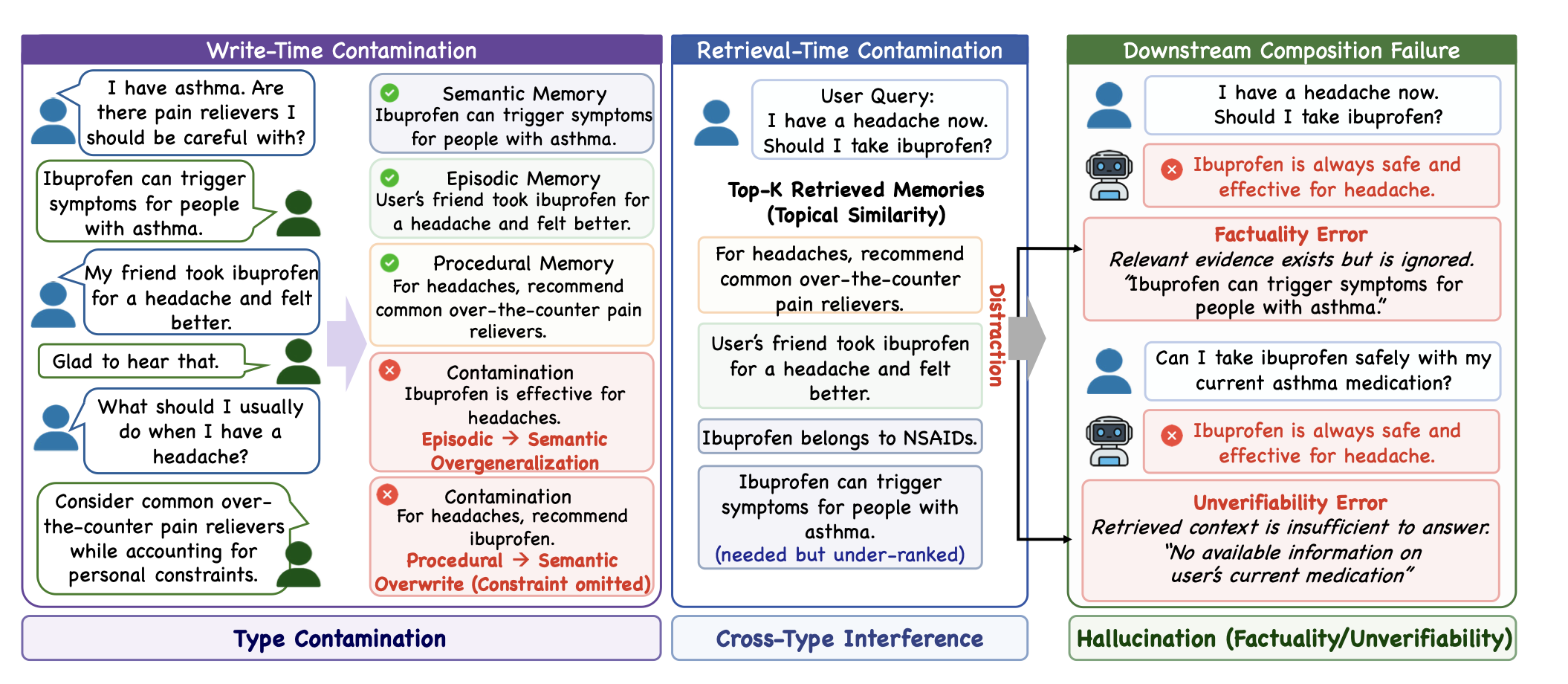
Heterogeneous memory contamination. Weak functional boundaries cause semantic constraints,
episodic observations, and procedural guidance to be stored, retrieved, and composed as interchangeable evidence.
The contamination propagates across writing and retrieval, producing persistent hallucinations.
01
At writing
An event becomes a general fact. A routine absorbs an exception. Without functional boundaries, different
kinds of knowledge can overwrite one another.
An experience→An unsupported belief
02
At retrieval
Topical similarity surfaces a familiar claim, but the question calls for a specific event. Relevant-looking
evidence can displace the evidence actually needed.
A general claim→The wrong event answer
03
Across time
Once a contaminated memory enters the system, it can be retrieved and reused. A local mistake becomes a
persistent source of hallucination.
Write↔Retrieve↔Reuse
Where the failures come from
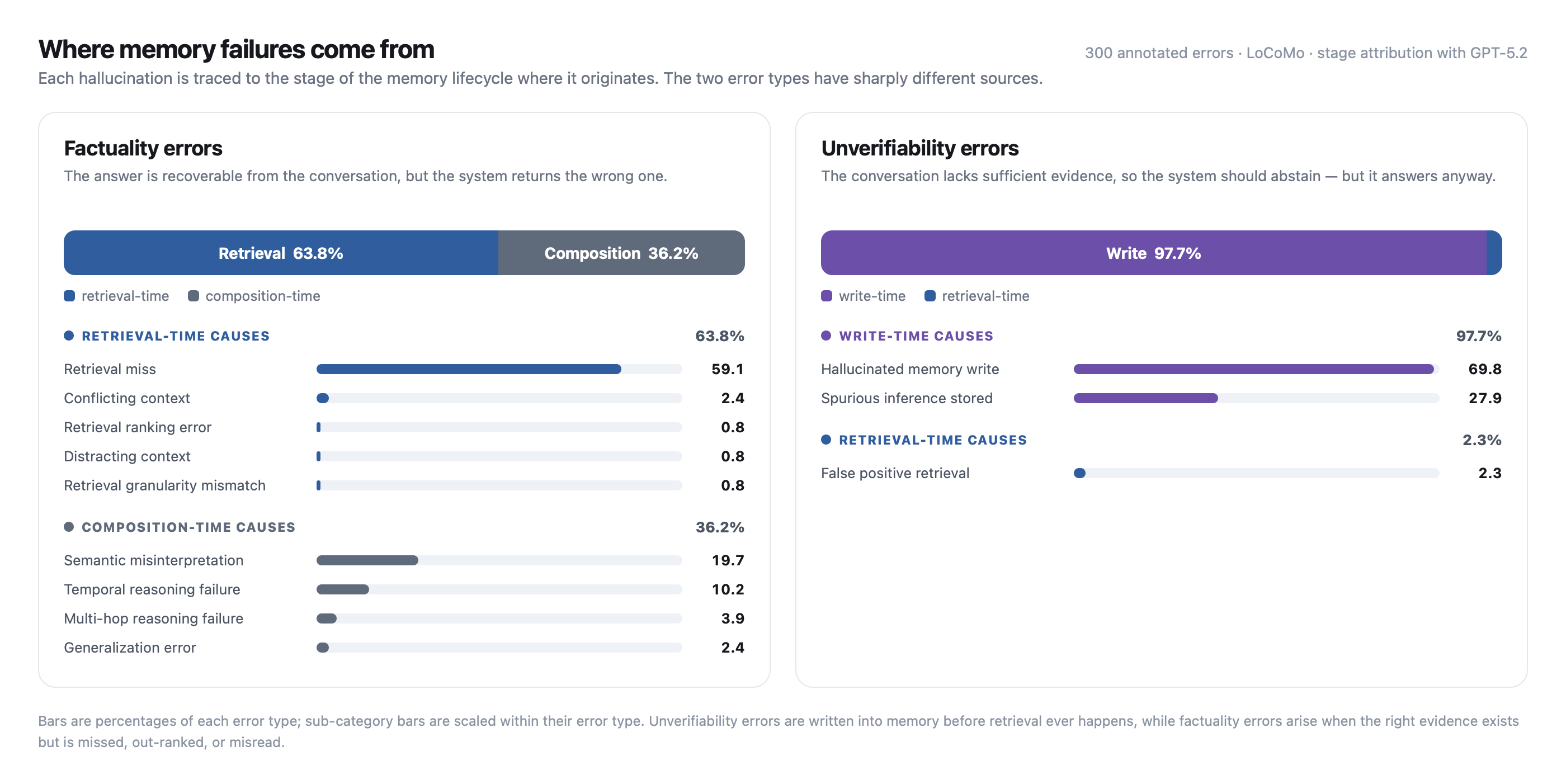
We annotate 300 incorrect responses on LoCoMo with their memory-lifecycle source, separating
factuality errors (the answer is recoverable from the conversation but the system gets it wrong) from
unverifiability errors (the evidence is insufficient, so the system should abstain but answers anyway).
The two error types have sharply different origins.
Error attribution across the memory lifecycle. Unverifiability errors are almost entirely
write-time (97.7%) — unsupported knowledge is stored before retrieval ever happens — while
factuality errors are dominated by retrieval-time contamination (63.8%), where the right evidence exists but
is missed or out-ranked.
Method
MemGuard: functional boundaries as a reliability constraint
Three memory stores. A query-dependent retrieval budget. Explicit relations that reconnect useful
evidence.
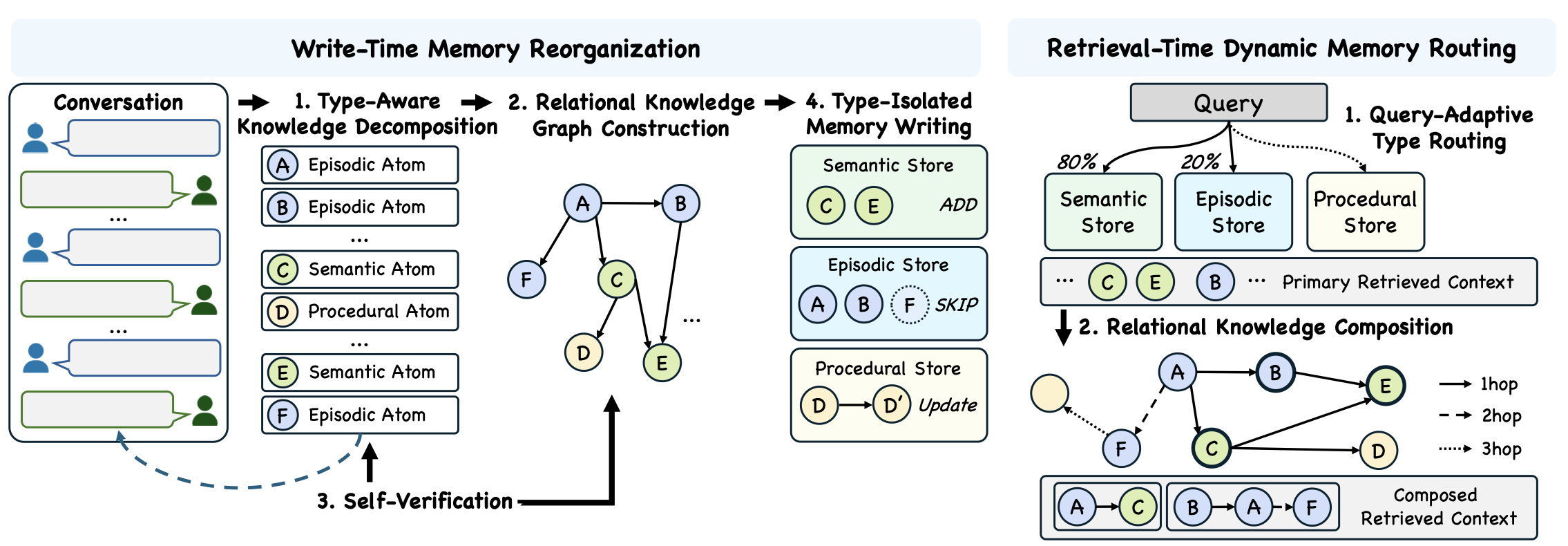
Overview of MemGuard. At write time, MemGuard reorganizes a conversation into atomic knowledge
units, constructs directed relations among them, verifies missing information, and writes each atom to a
type-isolated memory store. At retrieval time, the model routes queries adaptively to relevant memory types and
selectively composes retrieved atoms via a relational knowledge graph, reducing cross-type interference.
01 / Write
Type-aware reorganization
Decompose dialogue into atomic memories. Compare, add, update, or skip each atom within its own type's store.
SemanticFacts & beliefs
EpisodicEvents & experiences
ProceduralRoutines & behaviors
Cross-type dependencies become graph links, preserving separate records.
02 / Route
Query-adaptive retrieval
Estimate which memory types the question needs. Allocate the primary retrieval budget across those stores.
Semantic20%
Episodic30%
Procedural50%
Routing recorded for the case above. K = 20: 4 semantic, 6 episodic, and 10 procedural slots.
03 / Compose
Relational knowledge composition
Expand retrieved atoms through labeled graph edges, then rerank the composed evidence for the question.
Weekend routinesupports →Creative purpose
Actual retrieved relation. One-hop expansion; configured hop decay λ = 0.85.
Experimental Results
Cleaner memory, fewer tokens
Results span memory extraction, updating, and generation, together with long-horizon conversation
benchmarks.
89.53%
Anti-hallucination accuracy
HaluMem memory extraction MemGuard · 1 hop · Table 1
HaluMem · Table 1. Hallucination across the memory lifecycle; all values in percent.
Method
Extraction Acc. ↑
Extraction F1 ↑
Update correct ↑
Generation correct ↑
Generation halluc. ↓
Mem0
60.86
57.31
25.50
53.02
19.17
Mem0-Graph
61.86
57.85
24.50
54.66
19.28
Zep
–
–
47.28
55.47
21.92
MemOS
59.55
79.70
62.11
67.23
15.17
Memobase
32.29
25.13
5.20
35.33
29.97
Supermemory
60.83
56.90
16.37
54.07
22.24
MemGuard 1 hop
89.53
94.15
70.79
59.50
16.32
MemGuard 2 hops
89.49
94.11
71.49
58.26
16.61
Baselines are reported from HaluMem using GPT-4o; MemGuard uses GPT-4.1-mini with GPT-4.1
judging, so the comparison is conservative for MemGuard. A-Mem is not included in the paper's HaluMem table; the
demo above uses a separately supplied local A-Mem run, which is a different evaluation setting.
Long-horizon utility · Table 2. GPT-4.1-mini base / GPT-4.1 judge; accuracy in percent.
Method
Avg. retrieved tokens ↓
LoCoMo ↑
Adversarial ↑
PerLTQA ↑
LongMemEval ↑
A-Mem
7,244
59.62
64.35
80.62
62.25
MemGuard 1 hop
1,605
77.29
75.11
79.44
73.50
MemGuard 2 hops
1,540
79.10
76.46
80.07
72.25
MemGuard improves LoCoMo accuracy by 19.48 points over A-Mem at two hops while retrieving
about 4.7× fewer tokens in this setting. The 5.8× headline refers to the separate GPT-4o-mini setting
(1,250 vs. 7,244 tokens), where MemGuard also reaches 90.13% adversarial accuracy against A-Mem's 68.83%.
Routing and relational composition contribute complementary gains. Removing both lowers
accuracy by 8.46, 9.73, and 12.75 points on the three benchmarks respectively.
Boundaries + connections
Both components matter
Routing controls which kinds of memories enter retrieval. The graph restores useful dependencies that
similarity alone may miss. The ablations support using both.
Where the gains appear
Upstream reliability improves
The largest HaluMem gains are in extraction and updating. MemGuard does not lead every generation metric;
preserving memory is one part of a reliable answer pipeline.
All experimental values are transcribed from the paper, Tables 1–3 (pp. 7–8).
MemGuard does not control generation-time behavior, so composition errors can still occur even with correct retrieved
context, and the agentic memory pipeline adds LLM inference cost relative to end-to-end memory policies.
Citation
Building on MemGuard?
BibTeX
@inproceedings{ha2026memguard,
  title     = {MemGuard: Preventing Memory Contamination in Long-Term
               Memory-Augmented Large Language Models},
  author    = {Ha, Hyeonjeong and Kim, Jeonghwan and Qian, Cheng and Liu, Jiayu and
               Campbell, William M. and Wu, Yue and Zhang, Yuji and McKeown, Kathleen and
               Hakkani-T{\"u}r, Dilek and Ji, Heng},
  booktitle = {Findings of the Association for Computational Linguistics: EMNLP 2026},
  year      = {2026}
}